June 8, 2015

'Tis the season

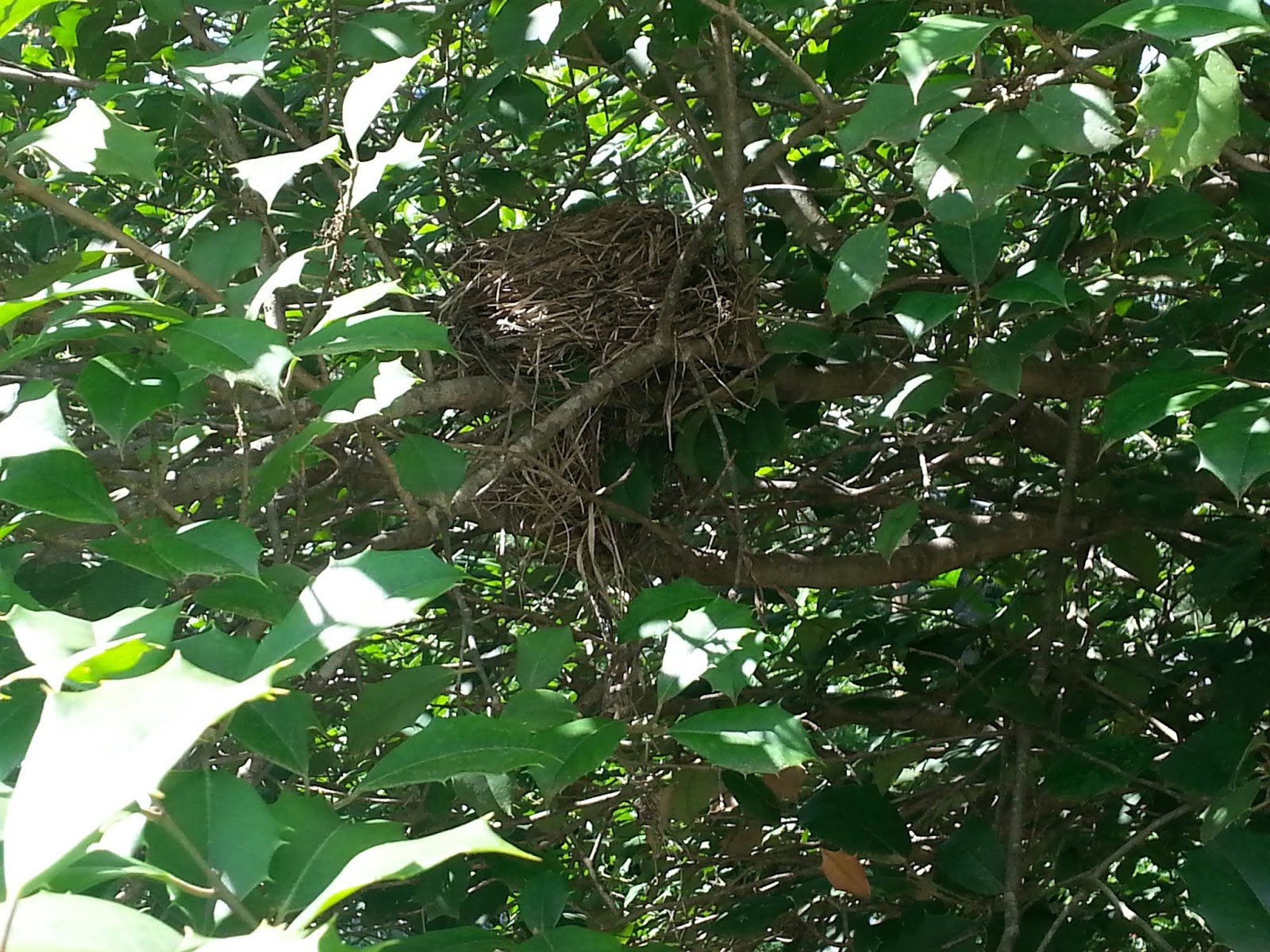
June is the season for new life on our little curve of a street. We've been sure for several days that birds were nesting in the holly tree outside our kitchen window. For nearly a month I've seen cardinals flying in and out of the prickly leaved branches, chattering away. I was positive there was a nest in there somewhere but couldn't see it. Peter spotted it near the top of the tree the other day, the same time he saw a sparrow nest lower in the holly branches.


 Farther out in our backyard, a cowbird family has nested in a dogwood tree, but the nest is nearly invisible. Only a birdwatcher like my husband can see it.


 A few yards down the garden, a wren house has its usual spring occupants. 


And last Saturday, just before dawn a baby boy was born next door. Babies and new life abound on McGee this June! All welcome signs of hope in the future and the bonds of family love.


May 25, 2015

By one of those wonderful coincidences that make life so interesting, the book CONSCIENCE arrived in my mailbox today--Memorial Day--the day we set aside to commemorate and honor those who fought in the wars our country has waged over the years. (It's also a legal holiday and there was no mail delivery--except for this book.)

Written by Louisa Thomas, the book explores her great-grandfather's life and the beliefs that impacted his decisions over the years. Norman Thomas and his three brothers were raised in a religious home, but they each followed a path formed by his own conscience. At the beginning of World War I, Norman was a Presbyterian minister, but by the end of that terrible war, he had become a pacifist. One of his brothers was sentenced to prison for life because he was a conscientious objector. The other two brothers joined the military and served in that "war to end all wars."

Norman Thomas' book,THE CONSCIENTIOUS OBJECTOR IN AMERICA, begins with this dedication:
"To the brave who went for conscience' sake to trench or prison." Although the four Thomas brothers often disagreed, they apparently came to respect one another's choices.

I've just begun reading CONSCIENCE, but already I feel a connection. the family in my book CALLAHAN CROSSROADS is divided over the right way to respond to Woodrow Wilson's call to serve in the war. The twelve-year-old narrator George begins to realize that things are not always black and white and that each person has to make an individual choice, according to what he or she thinks and believes.

I'm glad Louisa Thomas' book arrived on Memorial Day. Just the first few pages offer insights into conscience--how it's formed, how it changes and how it impacts our lives. It promises to be a thoughtful read.


February 20, 2015

WHOSE LIFE IS MADE BETTER?

We Americans often say that people from foreign countries emigrate to the US in order to find a "better life." I'm sure that's true. Today and throughout our country's brief history, others have sought our shores to escape poverty, prejudice, and lately, terrorism and its effects. They've come seeking freedom and all that word implies.

But in the past two weeks, I've had occasion to look at immigration in another light. First, a woman from South Vietnam cut and styled my hair. She was outgoing and pleasant and did a good job on my hair, giving me just the cut I'd asked for.

A few days later I went to a lab for a routine test. At this time of year, the usual opening conversation is about the weather, which in the Midwest jumps from frigid to warm in a matter of a day. When I called this "yo-yo" weather, the technician looked puzzled. I demonstrated how the toy works, going up and down, and she smiled. "I remember this from my physics course." We began talking about idioms and how they take one deeper into the cultural aspects of language. She asked if I'd read The Kite Runner (I had read that wonderful novel.) and told me she was from the same ethnic group as the main character.

During the following week, I went with my husband to visit his cardiologist, a quietly confident, friendly man from India. His nurse, calm and pleasant, was from Laos. They both answered questions and offered reassurance as we talked.

So, in the course of several days, a beautician from South Vietnam, a technician from Afghanistan, a physcian from India and his nurse from Laos all offered me kindness, professionalism, courtesy and provided me with a variety of services.

I'm trusting that their lives are better than in the country they came from. I know for sure that my life was made better because they're here!

August 16, 2014

MORE GARDEN THOUGHTS


I last posted here in June and wrote about my tendency to have incredibly clever ideas for writing while I was planting and weeding in my backyard garden. I lamented that as soon as I stepped inside, those ideas vanished before I could sit down at my laptop or even make a quick note on paper. Summer's drawing to a close and now I'm reaping tomatoes and argula and and summer squash and kale--and, of course, still weeding.

Tomatoes, fresh from my garden. 


I'm also reaping ideas while gardening, but they seem to be more remembrances than the creation of something new. I've just finished a massive revision of THE PRIVATE WARS OF G. P. CALLAHAN and so am on a writing furlough for the moment. My gardening thoughts have turned to memories of friends and loved ones. People dear to me, important to me, some of whom I haven't called or emailed for too long a time.


My garden thoughts fly away.


While pulling weeds, I remember the past and make a promise to myself that I'll drop an old friend a line, or email a sister-in-law, or give an elderly friend from church a call. But, like my writing ideas, those promises seem to fly away before I step inside my home.


Why does this happen? I'm not sure. Could be that the duties of my "inside" life crowd away any thoughts I had in the sunshine. Could be that my attention span is way too short. Or maybe my brain can't handle more than one thought at
a time. Surely it's not because I'm growing old!

I once told a friend that, although I hadn't called for a while, I often thought of her. She assured me that she believes that whenever we think of someone, it's a blessing for that person. It's as if we're offering a prayer for her, even though she may never know it. I find that comforting. This summer I've prayed for lots of people! Amen.

June 9, 2014

BLOGGING IN THE GARDEN

I wish could store ideas in this fanciful hat until I get to the computer.
I'm appalled to see how long it's been since I've posted anything here. It's not because I haven't composed any blogs. It's just that I seem to come up with ideas and their development while I'm digging or weeding or planting something in the garden. I'm full of meaningful thoughts and clever ways to embellish them when I'm outdoors, but they all seem to elude me once I'm inside, where phone calls and bills and unfinished manuscripts take me away from my garden thoughts.

It's as if my mind opens up when I'm down in the dirt. Ideas are planted and nourished. A blog thought blossoms into unbelievable beauty and depth. I smile as I weed, picturing readers who will be amazed at my clever turn of phrase or unusual take on a news item.

Then the wind of life blows across my garden plot and pulls me inside. All those ideas scatter like seeds not planted deeply enough and I can't retrieve them. Sigh!

Well, at least today I've managed to sit down and blog about not blogging. There are parallels I could draw here to the writing process, but I'll think about that tomorrow.

February 19, 2014

IN THE PARKS...

Peace Park in Hong Kong is dedicated to those who died in WWII.
Dragon statue in Zodiac Park, Kowloon.

 One of the most interesting aspects of our trip to China and Hong Kong was the chance to see how the residents use their parks. All ages took part in activities there, from senior citizens knitting or practicing qigong or tai chi to young adults dancing and playing games. China's parks are well used, and tourists are welcome to enjoy the fresh air and beauty, as well as to join in the fun!


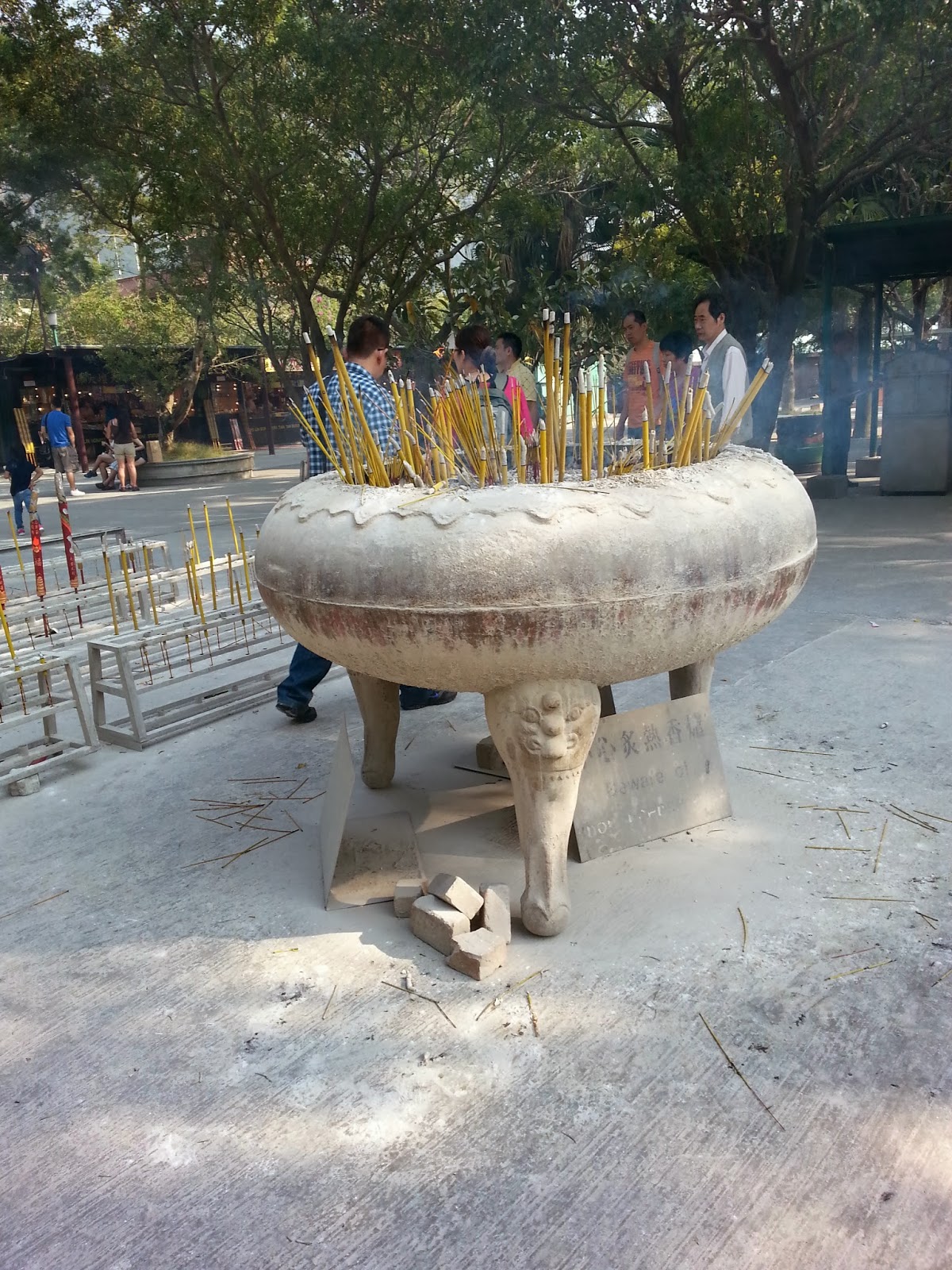
People light candles in the Great Buddha park.


What a polite way to say "Keep off the Grass!" (Happy is the tender grass when here your feet do not trespass!)


Young adults play keep-away in waterside park on Llama Island near Hong Kong.


Tourists join the dance in Beijing.


Hacken sack with a feathered birdie. Looks like fun!

More dancers. Two-step to "Red River Valley."
Water calligraphy. Beautiful and artistic. It disappears when the water dries. A good example of valuing the process, not just the product.

A covered walkway in Beijing's Peoples Park was lined with knitters and people playing Mah Jongg, chess and checkers.

February 3, 2014

THE PANDA!

Pandas like to climb and take shelter in hollow trees or rock crevices.
LUNCH BREAK AT THE ZOO

On a rainy day in Chongqing, we visited the zoo's panda pavilion at lunch time.

We were able to see six pandas doing what pandas do best--eat bamboo. Although there were bamboo structures similar to a school jungle gym in each enclosure, we were told that these gentle giants mostly eat and sleep.

It soon became obvious why these intriguing bears are considered China's National Treasure!

They are solitary creatures and don't mind turning their backs on visitors.


UNLESS THEY'RE BUSY EATING!


 ...and eating

...and eating


                                                                   ..and eating some more.


 The last enclosure we visited seemed larger than the others, and the eldest female resides there. She's the mother/grandmother of several of the pandas in the zoo and seemed happy to rest on her laurels.

A panda cub is pink, blind and toothless when born and weighs from 3 to 5 ounces, about 1/800th of its mother's weight. When we visited, a mother and her newborn cub were in isolation, so we weren't able to see this tiny miracle in person.
Grandma bear enjoys her lunch--and solitude.


In the past pandas were thought to be rare and noble creatures. The Empress Dowager Bo was buried with a panda skull in her vault. Today pandas are rare and considered endangered. Their natural habitat in the Sichuan province was been named a UNESCO World Heritage Site.

January 23, 2014

THE GREAT WALL AND BEYOND

As amazing as the wall is, its surrounding scenery is breathtaking!
We found the Great Wall fascinating, but
were also pleasantly surprised to find that it
wound its way through gorgeous mountains and foliage.

The Great Wall is actually a discontinuous network of wall segments built by various dynasties to protect China's northern boundary.

It's usually included in the list of the
Seven Wonders of the Medieval World and
is on UNESCO's list of great national and
historical sites.

The wall is around 2,145 miles long,
with an extra 1,770 miles of branches
and spurs. Parts of it are over 2000 years old.
Built for military defense, the wall accommodated traffic of soldiers, horses, and vehicles.

It's estimated that more than 1,000,000 workers died during the wall's construction.

A view of autumn splendor from the wall.

View from a watchtower.

From this vantage point, soldiers used weapons such as axes, sledge hammers,
crossbows, and gunpowder--a Chinese invention

The western section also provided defense for those traveling the Silk Road.

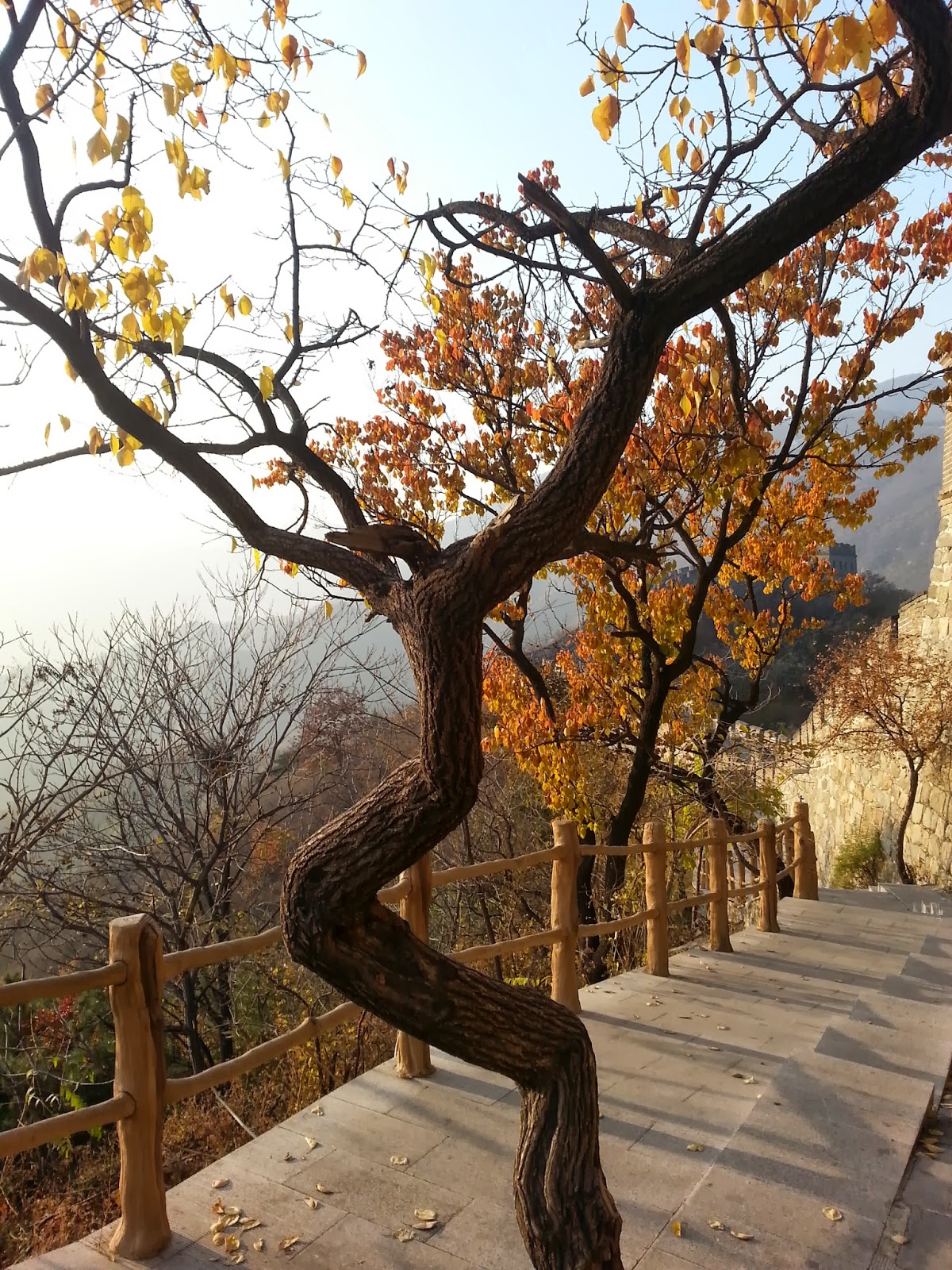
The wall was begun over 2000 years ago. Today, this tree
guards one of the ramps built for handicapped access.

Tourists taking the stairs to an entrance. Lots of climbing!


January 17, 2014

TRAVEL SURPRISES


We recently returned from a trip to Hong Kong and China and, as always, our travels were sprinkled with surprises. In addition to exploring the Great Wall, enjoying a delicious variety of regional food, marveling at the Terra Cotta Soldiers, Tianenmen Square, the Summer Palace, the Li and Yangtze rivers, and all the natural and architectural and historic sites, we constantly encountered the unexpected.

HALLOWEEN Trick or Treat...In both Hong Kong and China, 
we found evidence of Halloween celebrations. 
A street market in Hong Kong offered scary pastries and 
vendors in costume. When we arrived at our hotel in Xi'an, China, 
it was Halloween night. Costumed staff greeted us 
with light-up skull pins left over from a celebration. 


Uniforms, backpacks, phones and vigilant teachers.
FIELD TRIPS  are the same everywhere in the world, it seems. Our first day in Beijing, we visited Tianenman Square and found ourselves touring behind a school field trip. The students' bright blue uniforms made them easy to spot. Ten-year-old chatter and antics are universal!


Muslim Quarter Market


GULLIN LADIES
Outside Gullin, we visited a 350-year-old
house where two widowed sisters-in-law 
lived. Their children had built them a
new home, but they preferred to live
here, in what was originally a general's
home. They proudly showed us their
possessions, including a coffin!


ANOTHER XI'AN SURPRISE
Our second day in Xian we visited the
Muslim Quarter of that city, which is on the eastern edge of the Silk Road. We learned that there has been a sizable Muslim population in that region for over 1000 years, a result of the Silk Road trade route.


Widow proudly displays her coffin made by a son.

THREE GORGES DAM
Wherever we went, people wanted their photo taken with our group's redhead or with our tallest white-haired Gweilo. At the Three Gorges Dam park, several "redheads" got in the act.
At the Three Gorges Dam, a group shot of redheads!


                          Shanghai Book Store's Children's Book Section
               SHANGHAI DOUBLE SURPRISE
Like a giant Barnes and Noble, the Shanghai
Book Store is seven stories of every
imaginable book genre, plus games
and puzzles, stationery and cards, and, of
course, a Starbucks. While we sipped our
latte and herbal tea, we enjoyed Christmas
music. So there we were in Shanghai listening to
Feliz Navidad. Surprise!

We had trouble finding the store and
stopped at a police station for help.
No one there spoke English but we
were able to convey what we were looking for
and a police woman walked us to the corner
and pointed down the street. Surprise!

September 23, 2013

TWO-THIRDS ISN'T ENOUGH

This morning, as I was sipping coffee and reading the few pages that now constitute the Monday morning newspaper, our lights went out. At least some of them did. In the kitchen, the fridge was still operating, but not the stove. The toaster worked, but not the microwave. Our computers were powerless, as were our chargers and garage door opener. The overhead light fixtures--in some rooms--worked, but not in others. Most table lamps lit up, but not all.

The automated response to a call to the power company promised that they were working to fix our problem. We were mystified about how they could tell what the problem was, much less fix it from a distance.  A few hours later a lineman came to climb our electric pole and investigate. He reported that one of the three lines into our house had come loose. It took him a while, but he repaired the line and seemed as pleased about that as we were.

This episode reminds me that two-thirds is never as good as the whole. Writing a novel involves at least three-thirds: plot, setting and characters. Try writing with only two of the three. I've gotten carried away with one of the three, jumping into great detail about a character's appearance and back story but forgetting the she exists in a time and place or that she has a problem to solve. So, like an effective electricity delivery system, it's good to keep all three wires firmly in place--at all times. If one comes loose and loses power, so does the novel.

September 16, 2013

TOO MUCH OF A GOOD THING

I've learned that the research notes I accumulate while writing a historical novel can often lead me astray. I can get so immersed in the fascinating facts I'm uncovering that I forget my purpose--to write a piece of historical fiction that will carry young readers to a different time and place where they'll follow a likeable,  interesting character as s/he faces difficulties and solves a problem.

Two weeks ago I was working on a chapter of a new book set during World War I. It takes place in Kansas City and focuses on life on the Hone Front of the war. I had discovered a government leaflet about making a fireless cooker, the 1918 version of today's Crockpot. The main character's mother is continually thinking up projects to keep him busy and out of trouble, so making the cooker seemed like a gift from the research gods. I could show that the need to preserve energy and cook nutritiously was prevalent nearly a century ago.

The government's directions were detailed and precise. Too much so. My character and his buddy got so involved in the materials needed and the steps to construct the cooker that I lost track of my story. It turned into a massive info dump without adding anything to the plot and without revealing anything new about the characters. Three paragraphs of lists and instructions.

"Whoa!" was the unspoken but clear sentiment of my critique group. Did they really need to know all this? No. Did they find it interesting? A bit. Did they think I should deeply cut it? YES!

So I did and ended with three short sentences of dialogue that indicated what the cooker was for and that it was way too complicated for two 12-year-old boys to actually build. I was able to get across the government's purpose in promoting it during wartime.

I've always had this problem with research. I fall in love with every little detail, which leads me to another set of details and then to another and so on. I usually end up far afield from where I started, but fascinated by what I find in the process. I need to learn when to hold and when to fold when it comes to historical research so that I'll have a winning hand when I sit down to write!

August 26, 2013

THE WRITING GENE

This summer I came across a file of family mementoes that included two tributes my father had written to honor fellow workers at their retirement parties. His job was hard manual labor--working to maintain the turbines that supply electric power to our area. The men he worked with over the years had a special camaraderie heavily seasoned with "powerhouse" humor. Both show through in my father's writing as he sent two friends off into the world of retirement.

I reflected, as I read his words, that people who didn't know my dad would have been surprised to learn that he read a lot. I remember complete sets of Rudyard Kipling and Mark Twain on our bookshelves, alongside the encyclopedia set that played a big part in our dinner table discussions. Those same folks would never have suspected that my father had a flair for composition. In those two tributes, he managed to honor the personality and character of each man and also point out their foibles with gentle humor.

Over the past weekend, I discovered a delicious piece of writing by my mother. Although she graduated high school with a scholarship to a local college, she couldn't afford to buy the textbooks and so didn't use the scholarship. Years later, when her children were mostly grown, she enrolled in another local college and began taking night classes. For one of her English classes, she wrote a humorous essay titled, "Food for Thought." It makes clear that eating out with six children is an adventure full of surprises.

So, both my parents had a way with words. Maybe there is a writing gene. My five siblings and I have inherited it in different ways. Some of us are eloquent speakers (not me!) and some lean toward the written expression of how we feel or what we believe. Like my parents, we all love to tell a good story--and none of us are above embellishing it a bit!

August 15, 2013

SERENDIPITY PART TWO

I recently posted something about serendipity and since then I've thought about how much it plays into things--at least for me. I have no idea what gave me the plan to introduce WHISPER ISLAND by having someone portray Primmy. Imagination? Inspiration? Probably both. But when I mentioned the idea to my friend Joyce and asked if she thought her granddaughter Deanna would be interested in a little acting gig on the Outer Banks, she jumped at it, as did her daughter Nancy, Joyce's sister Brenda, and the very talented young lady, Deanna.

Primmy and I enjoy a good laugh.
They were all on board and laid plans to meet in Rodanthe for the book's official launch on July 10. What a week we had! Deanna, besides being a poet, singer, musician, artist, is also a very convincing actress. She put across the character and voice of Primmy, the main character. More than that, she answered questions as if she were the character and made it clear that she'd read the book and understood it.

I'm so fortunate to have had her innumerable talents in North Carolina and again for two signings in Kansas City. I look forward to more outings with Primmy--and to more visits from my Serendipity muse!
"No, you can't be a Life-Saver. It's too hard for a girl. Drat!"
   

Primmy and her new friend on the Outer Banks.


August 6, 2013

TRAVEL SIGNS

A friend of mine recently returned from a trip to England and was sharing some photos from the trip. Many of them were signs she'd seen along the way, and we teased her about her choice of significant photo ops.

I've rethought that. After my trip to the Outer Banks to launch WHISPER ISLAND, I looked over my photos and found that I'd captured several pics of signs that had caught my attention. They all seem to capture the spirit and ambience of the place where I shot them.

Ocracoke is a small island, but the main road gets lots of traffic.
This sign reminds folks to be extra careful as they pass through.


Lunch at water's edge at the Jolly Roger in Ocracoke was fun--until the storm set in. Maybe the pirate on the sign knew something that we didn't.

In case you didn't get the message, this gull made sure you kept your casting low.
Parents at the Gulf Coast Cafe get fair warning to mind their kids.
This sign by the front door of our little cottage-by-the-ocean says it all!

July 30, 2013

SERENDIPITY

As a writer, I've learned to be on the lookout for those serendipitous signs that might lead me to a new book idea or unstick me from a plot point I've gotten hung up on. It might come in a bit of a overheard conversation. I might come across an article or photograph that meshes with what I'm writing--or planning to write. Sometimes a dream--mine or someone else's--connects.

I know along the way I’ve missed some of those signs. Often I’ve neglected to make a written note about them, sure that I'd remember. Years ago, that might have worked, but now I'm less and less skillful at recalling even the most significant markers of my day.

For some reason unclear to me, I've begun to think more and more about a sequel for WHISPER ISLAND. It might be because I've become attached to Primmy and her independent character. I want to see where her free spirit takes her. At the same time, I've learned more and more about a dramatic, heroic rescue of the British tanker Mirlo off the shores of Rodanthe during World War I.

I'm now in the middle of a historical novel set in Kansas City during that "war to end all wars."

Serendipity has struck again! I've already done a lot of research about the war and I now know--and love--much of the history of the Outer Banks and ocean rescues. My research efforts could mesh in a sequel about Primmy six years after WHISPER ISLAND's story. I knew that she still would be kept from joining the Coast Guard (formerly the US Life-Saving Service), but I need to get her to Rodanthe as a seventeen-year-old young woman. What could she do for a living? What profession do I know most about? Teaching. Hard to imagine feisty Primmy as a schoolmarm, but I think she'd be spectacular!
"It's right across the road, Anola."

When I mentioned this idea to James Charlet, "keeper" of the Chicamacomico Life-Saving Historic Site, he pointed across the road. "That's the schoolhouse that would have been here in 1918." The building has been added to to create a community hall, but the central structure remains.

A sure sign that Primmy's story will continue!

July 24, 2013

Strolling Along Social Media Street

 I've learned over the years that writing a book is a play in three acts.

The curtain goes up on Act One, the birth of an idea that grows and develops in several scenes as the plot unfolds and characters enter and exit.

Act Two involves multiple scenes: writing, revising, rewriting, revising, editing, submitting, acceptance (eventually) and publication (finally).

Act Three may seem anti-climactic because the book is done, but for me that last act has been the most difficult. I've resisted the demands on my time and energy. I wanted to get on with my writing; the next book had already taken shape in my imagination and I longed to get it going. I've resisted jumping into the social media scene, but now I know I need to learn it all so I can give my latest book, WHISPER ISLAND, a good send-off. I've come to realize that, if a book was important enough to work on for several months, it deserves my efforts to get it before the public eye.

When I planned the WHISPER ISLAND launch at the Chicamacomico Life-Saving Historic Site in Rodanthe, NC, I knew that just traveling there and signing books wouldn't be enough to give my book the debut it deserved.
Rodanthe Beach,Outer Banks, North Carolina--another great place to stroll!
So several weeks before the launch I took some baby steps onto Social Media Street. Now I stroll along slowly but surely. I'm on Twitter and Pinterest and Facebook and LinkedIn. I own a smart phone. I tweet and pin and post. I have circles and pages. I've learned how to link and like.

And you know what? After the initial stress of learning something new, I'm beginning to enjoy it. I have a long way to go, but I'm getting there.