January 23, 2014

THE GREAT WALL AND BEYOND

As amazing as the wall is, its surrounding scenery is breathtaking!
We found the Great Wall fascinating, but
were also pleasantly surprised to find that it
wound its way through gorgeous mountains and foliage.

The Great Wall is actually a discontinuous network of wall segments built by various dynasties to protect China's northern boundary.

It's usually included in the list of the
Seven Wonders of the Medieval World and
is on UNESCO's list of great national and
historical sites.

The wall is around 2,145 miles long,
with an extra 1,770 miles of branches
and spurs. Parts of it are over 2000 years old.
Built for military defense, the wall accommodated traffic of soldiers, horses, and vehicles.

It's estimated that more than 1,000,000 workers died during the wall's construction.

A view of autumn splendor from the wall.

View from a watchtower.

From this vantage point, soldiers used weapons such as axes, sledge hammers,
crossbows, and gunpowder--a Chinese invention

The western section also provided defense for those traveling the Silk Road.

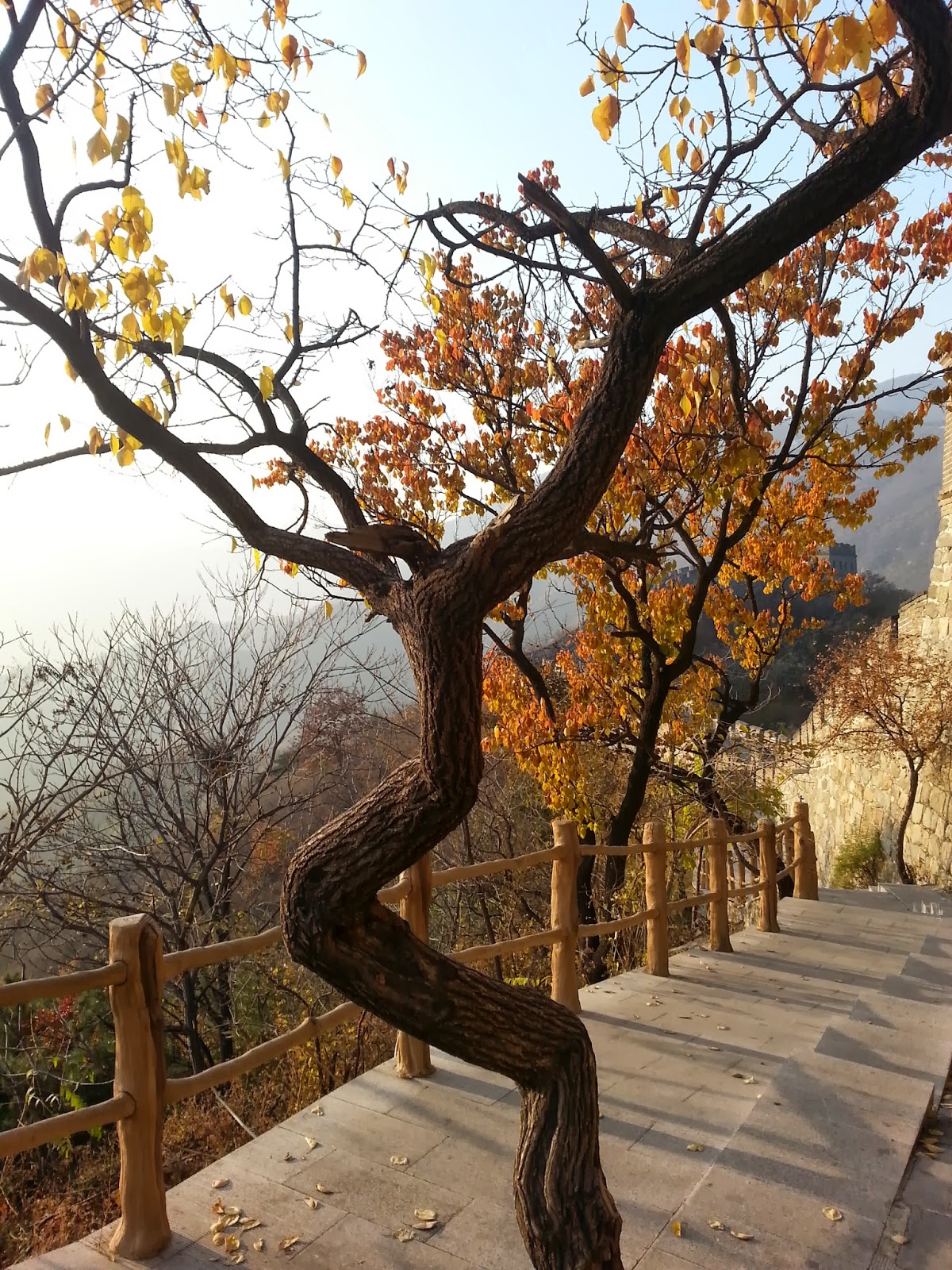
The wall was begun over 2000 years ago. Today, this tree
guards one of the ramps built for handicapped access.

Tourists taking the stairs to an entrance. Lots of climbing!


January 17, 2014

TRAVEL SURPRISES


We recently returned from a trip to Hong Kong and China and, as always, our travels were sprinkled with surprises. In addition to exploring the Great Wall, enjoying a delicious variety of regional food, marveling at the Terra Cotta Soldiers, Tianenmen Square, the Summer Palace, the Li and Yangtze rivers, and all the natural and architectural and historic sites, we constantly encountered the unexpected.

HALLOWEEN Trick or Treat...In both Hong Kong and China, 
we found evidence of Halloween celebrations. 
A street market in Hong Kong offered scary pastries and 
vendors in costume. When we arrived at our hotel in Xi'an, China, 
it was Halloween night. Costumed staff greeted us 
with light-up skull pins left over from a celebration. 


Uniforms, backpacks, phones and vigilant teachers.
FIELD TRIPS  are the same everywhere in the world, it seems. Our first day in Beijing, we visited Tianenman Square and found ourselves touring behind a school field trip. The students' bright blue uniforms made them easy to spot. Ten-year-old chatter and antics are universal!


Muslim Quarter Market


GULLIN LADIES
Outside Gullin, we visited a 350-year-old
house where two widowed sisters-in-law 
lived. Their children had built them a
new home, but they preferred to live
here, in what was originally a general's
home. They proudly showed us their
possessions, including a coffin!


ANOTHER XI'AN SURPRISE
Our second day in Xian we visited the
Muslim Quarter of that city, which is on the eastern edge of the Silk Road. We learned that there has been a sizable Muslim population in that region for over 1000 years, a result of the Silk Road trade route.


Widow proudly displays her coffin made by a son.

THREE GORGES DAM
Wherever we went, people wanted their photo taken with our group's redhead or with our tallest white-haired Gweilo. At the Three Gorges Dam park, several "redheads" got in the act.
At the Three Gorges Dam, a group shot of redheads!


                          Shanghai Book Store's Children's Book Section
               SHANGHAI DOUBLE SURPRISE
Like a giant Barnes and Noble, the Shanghai
Book Store is seven stories of every
imaginable book genre, plus games
and puzzles, stationery and cards, and, of
course, a Starbucks. While we sipped our
latte and herbal tea, we enjoyed Christmas
music. So there we were in Shanghai listening to
Feliz Navidad. Surprise!

We had trouble finding the store and
stopped at a police station for help.
No one there spoke English but we
were able to convey what we were looking for
and a police woman walked us to the corner
and pointed down the street. Surprise!

September 23, 2013

TWO-THIRDS ISN'T ENOUGH

This morning, as I was sipping coffee and reading the few pages that now constitute the Monday morning newspaper, our lights went out. At least some of them did. In the kitchen, the fridge was still operating, but not the stove. The toaster worked, but not the microwave. Our computers were powerless, as were our chargers and garage door opener. The overhead light fixtures--in some rooms--worked, but not in others. Most table lamps lit up, but not all.

The automated response to a call to the power company promised that they were working to fix our problem. We were mystified about how they could tell what the problem was, much less fix it from a distance.  A few hours later a lineman came to climb our electric pole and investigate. He reported that one of the three lines into our house had come loose. It took him a while, but he repaired the line and seemed as pleased about that as we were.

This episode reminds me that two-thirds is never as good as the whole. Writing a novel involves at least three-thirds: plot, setting and characters. Try writing with only two of the three. I've gotten carried away with one of the three, jumping into great detail about a character's appearance and back story but forgetting the she exists in a time and place or that she has a problem to solve. So, like an effective electricity delivery system, it's good to keep all three wires firmly in place--at all times. If one comes loose and loses power, so does the novel.

September 16, 2013

TOO MUCH OF A GOOD THING

I've learned that the research notes I accumulate while writing a historical novel can often lead me astray. I can get so immersed in the fascinating facts I'm uncovering that I forget my purpose--to write a piece of historical fiction that will carry young readers to a different time and place where they'll follow a likeable,  interesting character as s/he faces difficulties and solves a problem.

Two weeks ago I was working on a chapter of a new book set during World War I. It takes place in Kansas City and focuses on life on the Hone Front of the war. I had discovered a government leaflet about making a fireless cooker, the 1918 version of today's Crockpot. The main character's mother is continually thinking up projects to keep him busy and out of trouble, so making the cooker seemed like a gift from the research gods. I could show that the need to preserve energy and cook nutritiously was prevalent nearly a century ago.

The government's directions were detailed and precise. Too much so. My character and his buddy got so involved in the materials needed and the steps to construct the cooker that I lost track of my story. It turned into a massive info dump without adding anything to the plot and without revealing anything new about the characters. Three paragraphs of lists and instructions.

"Whoa!" was the unspoken but clear sentiment of my critique group. Did they really need to know all this? No. Did they find it interesting? A bit. Did they think I should deeply cut it? YES!

So I did and ended with three short sentences of dialogue that indicated what the cooker was for and that it was way too complicated for two 12-year-old boys to actually build. I was able to get across the government's purpose in promoting it during wartime.

I've always had this problem with research. I fall in love with every little detail, which leads me to another set of details and then to another and so on. I usually end up far afield from where I started, but fascinated by what I find in the process. I need to learn when to hold and when to fold when it comes to historical research so that I'll have a winning hand when I sit down to write!

August 26, 2013

THE WRITING GENE

This summer I came across a file of family mementoes that included two tributes my father had written to honor fellow workers at their retirement parties. His job was hard manual labor--working to maintain the turbines that supply electric power to our area. The men he worked with over the years had a special camaraderie heavily seasoned with "powerhouse" humor. Both show through in my father's writing as he sent two friends off into the world of retirement.

I reflected, as I read his words, that people who didn't know my dad would have been surprised to learn that he read a lot. I remember complete sets of Rudyard Kipling and Mark Twain on our bookshelves, alongside the encyclopedia set that played a big part in our dinner table discussions. Those same folks would never have suspected that my father had a flair for composition. In those two tributes, he managed to honor the personality and character of each man and also point out their foibles with gentle humor.

Over the past weekend, I discovered a delicious piece of writing by my mother. Although she graduated high school with a scholarship to a local college, she couldn't afford to buy the textbooks and so didn't use the scholarship. Years later, when her children were mostly grown, she enrolled in another local college and began taking night classes. For one of her English classes, she wrote a humorous essay titled, "Food for Thought." It makes clear that eating out with six children is an adventure full of surprises.

So, both my parents had a way with words. Maybe there is a writing gene. My five siblings and I have inherited it in different ways. Some of us are eloquent speakers (not me!) and some lean toward the written expression of how we feel or what we believe. Like my parents, we all love to tell a good story--and none of us are above embellishing it a bit!